
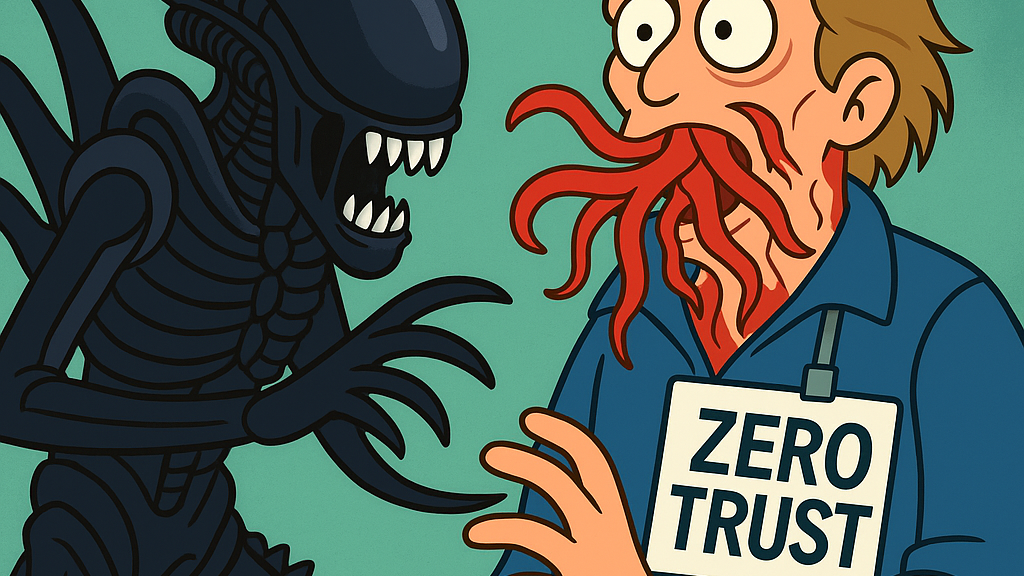
Two crews. Two outcomes. One Zero Trust lesson.
Alien, 1979
The crew of the Nostromo wakes up from hypersleep because of a distress call. Protocol says no one comes aboard without quarantine. But the captain overrules. They bring back Kane, with something attached to his face. No one stops it. No one isolates the risk.
At first, it looks harmless. The creature detaches. Kane wakes up. They think the danger is gone. They eat dinner together, relaxed, unguarded. Then it happens. The chestburster explodes out, and the nightmare begins.
From that moment forward, the ship is compromised. The alien hides in the vents, moves in secret, and picks the crew off one by one. Each system they rely on becomes a trap. Their own corridors become hostile.
The lesson is sharp: trust without verification destroys the team. The crew ignored a rule designed to protect them. They broke the chain of isolation. One weak choice spread across the ship. In Zero Trust terms, their quarantine policy failed, and the blast radius was total.
The Thing, 1982
A research station in Antarctica finds a dog running loose. It seems ordinary. They bring it inside. But this time, suspicion grows fast. The dog changes, splits, mutates. They realize it can imitate anyone.
The crew does not know who is safe. Trust becomes dangerous. So they build process. They lock suspects in separate rooms. They keep logs. They invent blood tests to confirm who is human. When tests are inconclusive, they retest. They do not assume.
Every step is built on the idea that verification matters more than convenience. Nobody gets a pass. Everyone must prove identity again and again. The crew enforces rules even under stress, because rules are the only thing holding them together.
The threat adapts, but their process adapts faster. Testing and isolation keep the group alive longer than instinct or luck ever could. They don’t eliminate risk, but they reduce it, contain it, and survive through rigor.
In Zero Trust terms, they understood the principle: never trust by default. Always verify. Limit movement. Keep records. And when the unknown presses, respond with discipline.
Zero Trust in plain words
- Monitor and respond
- Never trust by default
- Always verify
- Limit blast radius
Alien shows what happens when rules fail. The Thing shows how rigorous testing saves a team. Both stories map to what you should demand in your tenant.
Bring Zero Trust into your tenant with Business Premium
Identity
- Enforce MFA with number matching or FIDO2 keys
- Use Conditional Access to block legacy protocols and limit access by device, country, and app
- Assign least privilege and review admin roles often
Devices
- Enroll Windows, macOS, iOS, and Android in Intune
- Require compliance before granting access
- Enable Defender for Business with next-gen protection and automated remediation
Email and collaboration
- Safe Links and Safe Attachments stop malicious URLs and files
- Quarantine suspicious mail, train users to report phish
- Require sign-in for sharing, set link expirations
Data
- Use Sensitivity labels to encrypt and restrict files
- Apply DLP to stop sharing or copying sensitive info
- Log and alert on unusual file access
Sessions and access
- Require re-verification for sensitive apps
- Block unmanaged browsers with App Enforced Restrictions
- Protect mobile access with Intune App Protection
Operations
- Centralize alerts in Microsoft 365 Defender
- Standardize secure baselines with Intune templates
- Review access and settings every quarter
How Alien maps to your tenant
- Quarantine ignored → Conditional Access with MFA and device compliance
- Unknown lifeform aboard → Safe Attachments and Safe Links block the unknown
- Hidden movement through vents → DLP and Sensitivity labels reduce lateral movement
How The Thing maps to your tenant
- Constant testing → Sign-in frequency, compliance checks, and EDR
- Isolation of suspects → Least privilege and session restrictions
- Records guide decisions → Intune baselines and documented admin roles
Action plan for your team
- Turn on MFA for everyone
- Build three Conditional Access tiers: baseline, finance/HR, break-glass
- Enroll and require compliant devices
- Enable Defender, Safe Links, and Safe Attachments
- Apply Sensitivity labels and DLP
- Review roles, sharing, and alert rules every quarter
Teachable moment:
Run a tabletop exercise with your team. Map key scenes from Alien and The Thing to Microsoft 365 Business Premium controls.
- Alien’s broken quarantine → Conditional Access and MFA.
- The Thing’s blood tests → Sign-in frequency and device compliance.
- Alien’s hidden movement → DLP and Sensitivity labels.
- The Thing’s isolation of suspects → Least privilege and session restrictions.
This makes Zero Trust concrete. It shows staff why policies exist and how each control works in practice. Movies become lessons. Stories become strategy.
Zero Trust is not a slogan. Zero Trust is a workflow. Alien teaches the cost of breaking rules. The Thing proves the value of continuous testing.
Business Premium gives your team the same discipline. Conditional Access enforces quarantine. Defender stops threats at the door. Intune keeps devices honest. Sensitivity labels and DLP limit blast radius.
Bring the rigor from The Thing. Avoid the mistakes from Alien. Make Zero Trust your daily process.
Ready for the Next Step?