
Microsoft Just Raised Your M365 Business Plan Costs. Here’s What You Need to Know.
If you run a small or mid-size business on Microsoft 365, your monthly bill is going up. Starting July 1, 2026, Microsoft is increasing prices across its Business suite lineup, and if you haven’t looked at your renewal date recently, now is the time.
No drama needed here. Just the facts, some context, and a clear-eyed look at what you should actually do about it.
Here’s Exactly What’s Changing
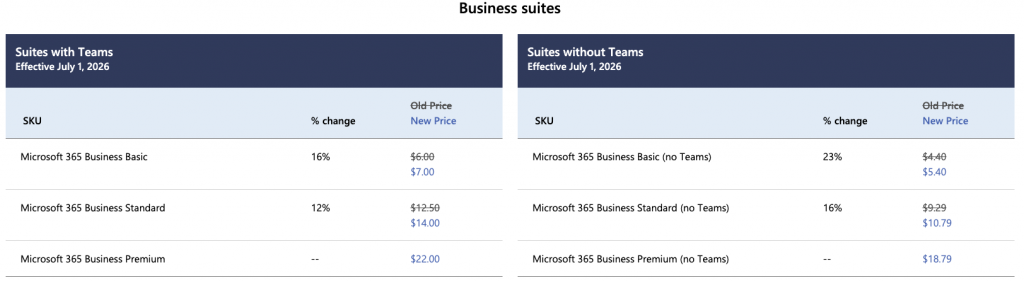
Those percentages feel small on paper. But when you run the math on your headcount …… it tells a different story. A 50-person company on Business Standard goes from paying $7,500 per year to $8,400. A 100-person company crosses into five figures of additional annual spend.
For a growing business watching every dollar of operating expense, that’s a real conversation to have with your finance team.
If you’re on the Teams-excluded versions, Business Basic without Teams moves from $4.40 to $5.40 per user monthly, a 23% increase. Business Standard without Teams goes from $9.29 to $10.79, a 16% jump!
Worth noting: Business Premium pricing holds steady. If you’re already on the top Business tier, you’re getting a free pass this cycle while your costs on lower tiers climb around you.
What You’re Getting in Return
Microsoft isn’t just sending you a higher invoice. There are new features rolling into the Business plans alongside the price increases, and a few of them are genuinely worth your attention.
Business Basic and Business Standard customers are getting an additional 50GB of email storage, URL time-of-click protection, Copilot Chat enhancements, and Copilot Chat Analytics rolling out in summer 2026.
The email storage bump is straightforward. Fifty extra gigabytes per user matters less for organizations using SharePoint and OneDrive heavily for file storage, but for businesses where users have been with the company a long time, that’s a meaningful quality-of-life improvement.
The URL time-of-click protection is worth paying attention to as well. This feature helps protect users against known malicious websites when they click on links in email and Office apps. For small and mid-size businesses that don’t have a dedicated security team watching threats in real time, this kind of automated protection filling a real gap.
And then there’s Copilot. Copilot Chat enhancements include context-aware intelligence and Agent Mode in Word, Excel, PowerPoint, and Outlook, bringing a unified AI chat experience right into the flow of work. Whether your team is ready to use it or not, it’s coming to your plan.
The million dollar question is whether you’ll build a plan to actually get value from it (we can help with that).
The Update Timeline You Need to Pin Down
Pricing updates take effect July 1, 2026. Packaging updates begin rolling out in June 2026. Existing customers remain on current pricing until renewal, and JRC Technologies will inform customers of the price increase before renewal. If your not working with a Mircrosoft partner reach out for a free assessment.
You won’t be flipped to new pricing mid-subscription. If your renewal is in September 2026, you stay on current pricing until then. If it’s in March 2026, you’ve likely already renewed at the old rate and won’t see the increase until your next cycle.
What You Should Actually Do Right Now
You’re probably not switching away from Microsoft 365. For most SMBs, the switching costs alone, the migration effort, the retraining, the lost integrations with tools like HubSpot, Salesforce, or DocuSign, make it a non-starter. But staying doesn’t mean accepting a higher bill without thinking it through.
Start with a license audit. This is the single highest-value action you can take. Most businesses have at least some users assigned to a plan tier that doesn’t match how they actually work. If your office manager uses email, Teams, and Word, they don’t need Business Standard. Business Basic covers them at a lower per-seat cost. That gap, multiplied across a dozen users, adds up fast.
Look at your add-ons. If you’ve been paying separately for third-party link protection tools or archiving solutions that Microsoft is now bundling into your plan, you might find that the price increase is partially or fully offset by eliminating those line items.
Let us help with the comparison before you assume the worst.
Talk to us before your renewal. We have access to pricing conversations that aren’t available if you’re managing your subscription directly through the Microsoft admin portal. Multi-year commitments, seat volume adjustments, and bundling discussions all happen at the partner level. Don’t skip that call.
Consider whether your current tier still fits. Business Premium at $22.00 per user is holding price right now. For businesses that need the advanced security features it includes, things like Microsoft Defender for Business, Intune device management, and Azure AD Premium, this tier’s value proposition actually got stronger relative to Standard with this announcement. If you’ve been on Business Standard and telling yourself you’ll “upgrade eventually,” this pricing shift might be the right moment to have that conversation seriously.
The AI Question You Can’t Ignore Forever
Copilot is landing in your Business plans: most SMBs aren’t ready for it yet, and that’s okay. But it’s arriving whether you’ve planned for it or not.
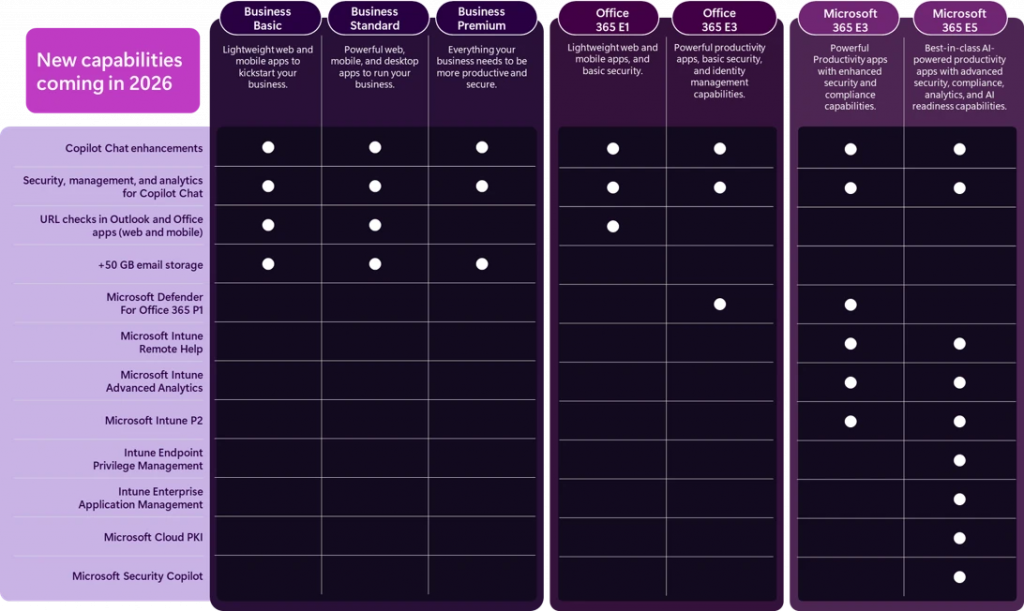
Copilot Chat Analytics will also be included, giving administrators visibility into how AI features are being used across the organization. microsoft That’s actually a useful tool for IT directors trying to figure out where AI is adding value and where it’s being ignored. Use it.
The organizations that will get the most out of this pricing change are the ones that treat it as a forcing function. You’re paying more. So what are you getting? Which features are your people actually using? Which ones are sitting dormant? A price increase is a reasonable moment to ask those questions out loud and build some accountability around the answers.
Your Renewal Date Is Everything
Know when your subscription renews. Talk to your licensing partner before that date arrives. Run a quick audit of what tier each user actually needs. And make a conscious decision about Copilot adoption before it lands in your tenant by default.
Microsoft 365 isn’t going anywhere for most businesses, and neither is Microsoft’s tendency to raise prices as it bundles more features into the platform. The businesses that manage this well are the ones with clear visibility into what they’re paying, what they’re using, and what renewal conversations to have before someone else makes those decisions for them.
Ready for the Next Step?